


Cayuga Terrace has a very special Guinness World Records holder.
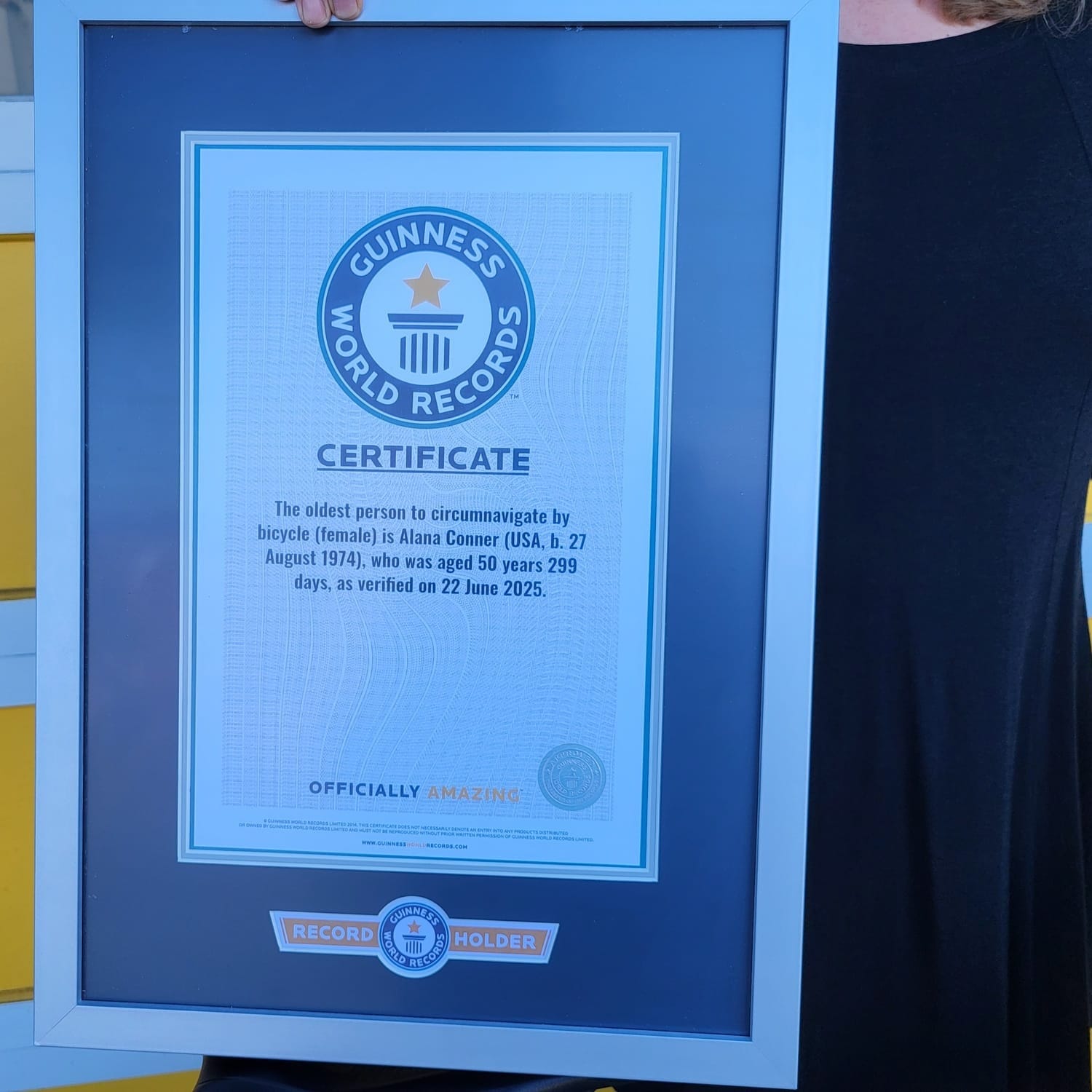
Alana Conner, 51, is the oldest woman to circumnavigate the world by bicycle. In 2024, the Memphis, Tenn. native had enough of working as a UX researcher for Google and set out to earn a world record title.
Conner departed from San Francisco’s Great Highway on April 14 with her custom-built steel gravel bike, which was made by Santa Rosa’s Jeremy Sycip and named after her paternal grandmother, Louise. She traveled through 22 countries, including two certification antipodes of Madrid, Spain, and Wellington, New Zealand, and just over 18,000 miles before returning to the then-renamed Sunset Dunes on June 22, 2025.
“I wanted to have a grand adventure in my life, and I also wanted other people to see me so that I might inspire them to have a grand adventure because for most of human history women have been stuck at home taking care of a bunch of people who don't say thank you,” Conner said. “We're now at a point in history where women can go forth and explore.”
Biking was never something the cultural and behavioral scientist was particularly fond of, but her apprehensive feelings changed when she did her master's program research in Japan and was given a bike to ride around on. She took her new love for biking back with her to San Francisco and continued to integrate it with her daily life, making it the perfect choice for her quest around the world.
Though she completed her journey in June last year, Conner has begun sharing details of her trip now, including in her upcoming book titled “A Look Around: A Middle-Aged Burnout Circles Her Planet on a Bicycle.” While her travels were at times grueling, Conner said that if she were given the opportunity, she would do it all again.
“The world is full of beauty and wonder, and most people are mostly good most of the time, and I feel like we're taught to fear the wrong things, including our own perceptions and our own dreams,” Conner said. “Now, I'm not advocating for people to go out there and become psychopaths, but I do think this, and I would say especially for women, especially women at midlife, really honor your dreams. Honor your truths.”
The Ingleside Light caught up with Conner to hear more about her journey across the world.
This interview has been edited for length and clarity.
How does it feel to be a world record holder?
It feels really good, because you realize, as a 51-year-old woman, you do realize there were inequalities and headwinds that men didn't have to face, but you somehow didn't think it applied to you and then to like reach this age and realize I've definitely had to push to have the kind of life I want and then to push open one more door. My sincerest hope is that a woman goes out there and breaks this record immediately.
What did a typical day on the road look like?
It's so funny, like a lot of cyclists get up really early. I did that when it was really hot. You've got to get it done, but typically I would wake up around 6:30 or 7 a.m. It would take me about two hours to get up, eat, stretch. I had a pretty extensive stretching and strength training regimen just to maintain the machine, this machine [my body,] and then I would pack up, pack up my bike, lubing my chain, dealing with any mechanical stuff. That all took about two hours.
I'd try to be out the door by nine. I didn't want to leave when there were people commuting to work just to thin out the traffic a little bit. Basically, it was a job. I'd bike till about four, three, or 5 p.m. On the ride, I'd stop every hour on the hour because my legs were unionized and they would have a union break, and I would take a photograph, eat a little something. I very often didn't eat a midday meal. I just kind of ate a lot of calories every hour. I probably ate three to four thousand calories a day. Except I couldn't always get that, and so I actually lost quite a bit of weight in China, which is not good because then I started to get injured because what starts to go is your tendons and your muscles. You don't ever try to lose weight on something like this.
My ideal day would be to figure out food before lodging, so I could just get eating done and go back or go to my hotel or campsite, take a shower. I tried to shower every night. I would wash my clothes every night. If I was staying inside, I'd try to put it in front of a fan or air conditioner. If I was staying outside, put it on my bike to dry, then I would call my husband and talk for 15 minutes, journal or often I had to figure out what was going to happen the next day: What is my route, what are my likely stopping places. What's a sure shot? What's a reach? What's the food situation on the route? Where am I going to need to refuel? Do I need to really load up now? So yeah, figuring out the next day's logistics and planning.
What challenges did you face? Did any take you by surprise?
Weather, terrain, injury, illness, mechanical issues, failures to plan, failures to anticipate.
I think the hardest day I had, the most surprising thing that happened was I had to reroute a few times because there was this thing called winter, and when you're riding by yourself, you don't want to ever be in winter because now you're in conditions that you can't really ride a bike in or certainly can't camp out in. You should always be prepared to camp out. So I had flown from Turkey to Western China, and I was in Ürümqi, which is the capital of the Xinjiang province, which is where this Uyghur genocide is going on. It's a police state. I kind of knew what I was getting into, and I thought I was prepared, but I wasn't. So in China, many of the technologies I relied on for communication and navigation no longer worked. They were illegal. They were blocked, so now communication and navigation is much more difficult. I had never test-driven my gear for carrying water and food multiple days and camping out in freezing weather, and that was precisely what was about to happen. I don't speak Mandarin.
I get to Ürümqi and then I realized, I rode out and promptly also realized the road I was going to take is illegal for cyclists and also strewn with debris that causes punctures, so that was the first time I think my trip was like, “I can't do this. I am now in danger. I could die doing this and I don't want to die.” So I tucked my tail, tucked back between my legs, and went back to the hotel I had stayed the night before…I had this big realization of like “Yeah, I can't do what I planned.” So I quickly retrenched and basically took a 36-hour train down to Southern China and totally rerouted through Southeast Asia.
How did you stay motivated?
It was just fun. The primary motivator of human behavior is fun. If something’s fun, people will do it. I mean, sure. I had all these lofty ambitions about inspiring women to undertake grand adventures and pushing our understanding of women's bodies at midlife and spreading acceptance of women athletes, but at the end of the day, I just had a fun time.
What is one piece of advice you have for someone who also wants to accomplish a similar goal?
Do it. I don't know what else to say about that other than don't let anyone talk you out, and don't talk to people who try to talk you out of it. Find people who are going to talk you into it. If you die doing it, if that's what you wanted to do, everybody's gonna die at some point. But seriously, I had people in my life who were not supportive… If you've got a dream, what else are we here for? You get one life, and it is wild and precious. What are you going to do with it? And sure, if you've got five kids to feed, maybe don't do the motorcycle trip. Get to a point in your life where you, taking the risk you need to take to pursue your dream, aren't going to needlessly harm or jeopardize other people.


