

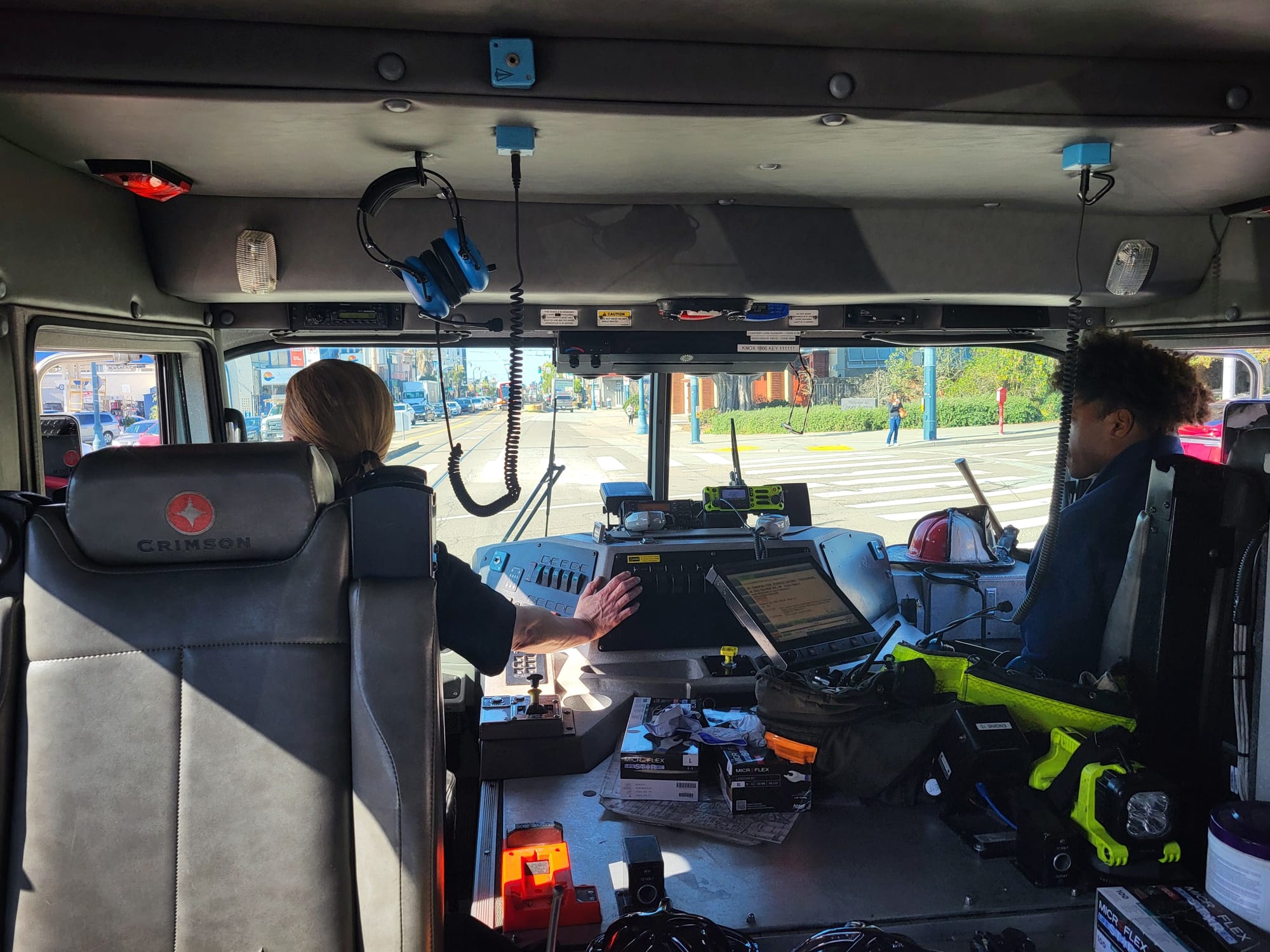
It’s not unusual to see the San Francisco Fire Department’s Engine 15 speeding down Ingleside’s Ocean Avenue from one emergency to the next, driven by the neighborhood’s very own Carla Kasper.
The Mission Terrace native joined the San Francisco Fire Department in 2000 at the age of 24. Though Kasper, 50, now resides in San Mateo with her three children and husband Marc, who is the Assistant Deputy Chief of Training for SFFD, she has found a second home at Station 15, a station that has also directly helped her family in times of need.
Kasper was placed permanently at the firehouse 19 years ago and has been driving the station’s engine for the last six years.
“I'm not going anywhere at this point,” Kasper said. “I'll probably retire here.”
Becoming a firefighter wasn’t the first career Kasper went for. After caring for her parents, Lorraine and Carlo Cirelli, Kasper wanted to pursue a job that helped people and considered becoming a paramedic, and even obtained her license in that field.
But after being urged to consider the fire department due to her active nature and strength, she volunteered for the fire reserves, and while attending San Francisco State University, she applied to SFFD and kick-started her firefighting career.
“It means a lot to me to be able to serve the community, especially the one that I grew up in, because I do still see a lot of familiar faces,” Kasper said. “I'm proud to represent my neighborhood working in a station where I grew up.”
The Ingleside Light caught up with Kasper to hear more about her SFFD journey.
This interview has been edited for length and clarity.
What was it like to run into a burning building for the first time?
I was on the truck, and it was downtown because it was Truck 2, it was Chinatown. I had to help throw the fire escape ladder and then climb up and tie it. It's funny because that was 26 years ago, and I do remember it like it was yesterday. I tied off the fire escape, and I came back down. I believe it was a restaurant, and then when you're brand new, you stick with your boss. You're glued to their hip, and I remember going in with him, and it was just really smoky and dark. I imagine it, not to say it's not intense, because there are fires that are very intense. I didn't know what to expect, but we were really on top of each other. It was a pretty confined space, so it made me feel safer knowing that there were so many of us kind of doing this together. We put the fire out. I wasn't on the engine; the engine put the fire out. On the truck, you have to look for extensions, so we have these ceiling hooks. You pull the ceiling, and then you have to overhaul everything that's burnt to bring it out. It was a very mellow, if you will, fire compared to other fires I've been to, but it was a good way to start.
What does a typical shift look like?
Shifts are from 8 a.m. to 8 a.m. and there are nine 24-hour shifts a month. Even though you start at 8:00, some people at this station anyway, get in at 6:30, some people will get in at 7:00, just so you can relieve the person who worked the day before. You don't want them to get a call at 8 a.m. because that's when they're supposed to be getting off. I got here at 7, and whoever drove yesterday could go. In the morning, until around 8:30, we have coffee, make breakfast, get dressed, talk, visit, whatever, joke around, and then at 8:30 at this station, we have a roll call. They ring the bell, and we all gather around in the communication room, and then we have a morning meeting. The officers and the chief say if there are any training things we need to go to or stuff going on in the department that we need to know about, we kind of talk about it there and then.
Right after roll call, it's housework. We live here just like you live in your house. We clean the bathrooms, mop the floors, clean up the kitchen and clean out the fridge if there's leftover stuff. The drivers go to their rigs. I go to the engine, and the driver and the tiller of the truck go, and they check all their equipment, start their saws. I go to the hydrant, make sure the engine's topped off with water, come back, and then we have a drill. We usually have some kind of drill every morning, especially now. We have two probationary firefighters, one on the engine and one on the truck, so we do something for them. The engine may go do hose leads, the truck throws ladders. Then whoever’s cooking, like today it’s me, the rig goes, and we might go grab a coffee first, and then we go shop and then come back, and there we're cooking and again have lunch, and sometimes there's drills in the afternoon, sometimes there's not, but then get ready for dinner. Fitness obviously is a big part of our job, so we have a gym. After lunch, if people want to work out, they work out. If there are no calls, we do have a dorm room upstairs, and we have beds, and we'll go get in them, and if we get to sleep, we get to sleep, and if not, there are these really loud tones that go off and let us know who's got to go where.
Do you have a favorite memory or crazy story from your career that you can share?
My house caught fire when I was 15 in January of 1992. My dad had had a stroke and couldn't really walk, so I had to get him out. It wasn't as dramatic as TV, but I did have to help get my dad out of the house, and this station came. That is one big reason why I'm so connected. When I first got here, all of the older guys like Al Hunt and Medrick Bullock, I grew up with them coming to my home, like when my father had seizures from his stroke, my mom had heart attacks. They probably met me when I was like eight or nine years old, and then the fire, and they knew my dad couldn't walk. Two of the guys ran in and came right up. I had already gotten him down, but they knew. They were like, “Hey, that's the address with the girl,” and then when I started working at this station, they were all still here, so now I worked with them. I met them at nine, helping my family, so that is a big part of it, and then they came to this fire that we had when I was 15 years old, and now I'm working with them. I remember the first day I walked in, Al Hunt was like “Hey, you're the little girl from Nantucket.”
What is one piece of advice you have for the community?
Don't be afraid to call. Some people hesitate because they don't want the sirens and everything showing up to their house. Better safe than sorry. Please don’t be afraid to call us even if it’s the smallest thing that you think is “Oh my God, this is so stupid. I shouldn’t.” Just call.