

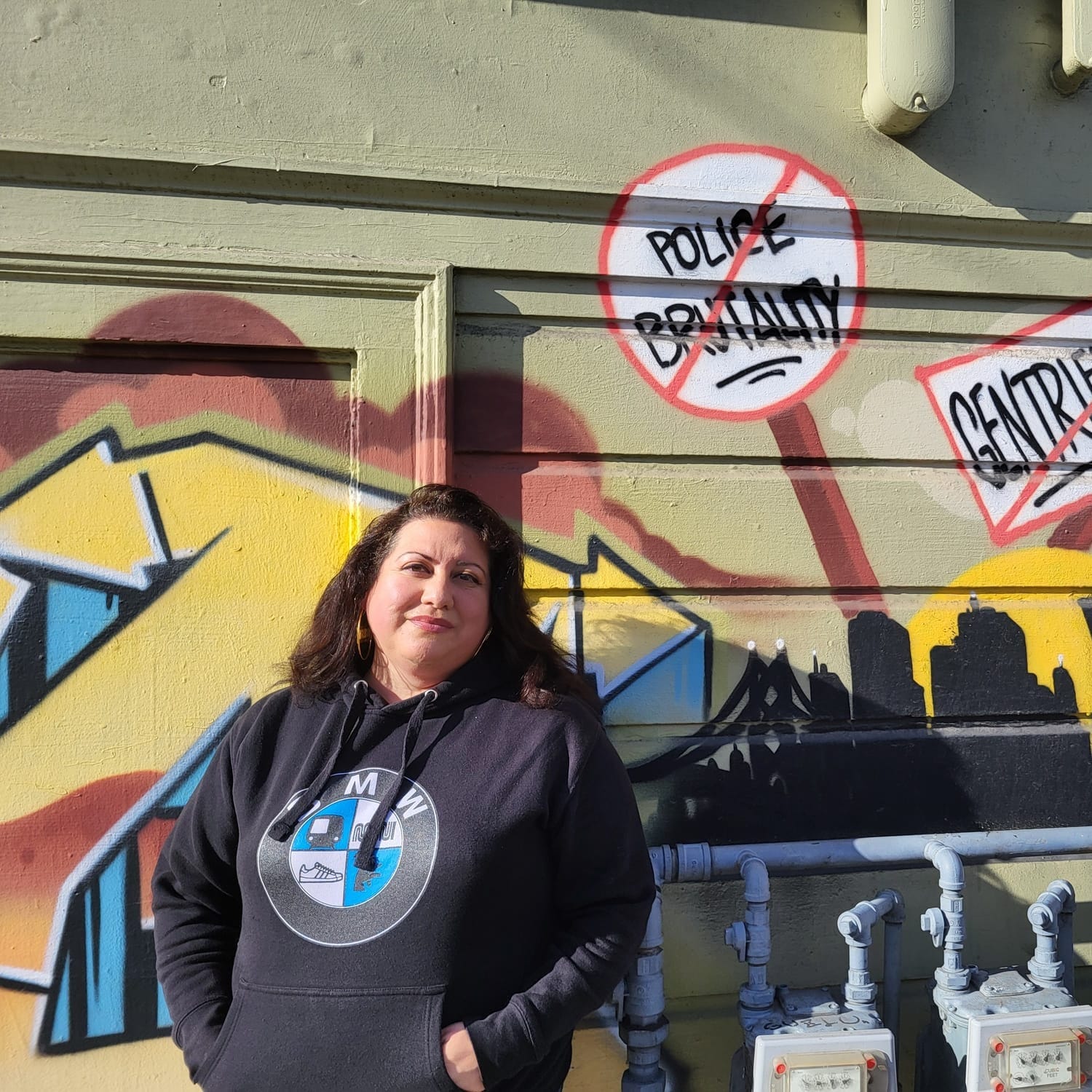
Patricia Barraza is bringing people together and working to protect community activations.
The Excelsior-native grew up engaged in her community with groups such as the Corpus Christi church system, United Playaz and City Hall’s youth commission. As an adult, she worked as an after-school program coordinator at John O’ Connell High School and then as director of the James Denman Middle School Beacon Center. Barraza has dived into community organizing, like Excelsior Strong, to bring neighbors together, and now, as Livable City’s director of community activations and partnerships Livable City, she is channeling that momentum to keep the popular activation Sunday Streets alive after a 100% funding cut by City Hall.
“I've always kind of been that ‘in the back’ person, and even now my goal is that at Sunday Streets these organizations are highlighted and they're showing the amazing things that they're doing and that I'm just kind of in the background making sure it all happens,” Barraza said.
Sunday Streets, the city’s open streets program through Livable City that brings a day of outdoor activities to several neighborhoods, faced drastic budget cuts from city partners like the Department of Public Health in February, a majority of which Livable City relied on. But thanks to online fundraising, a generous donation from a private source, and a match of funds, the program will continue for half a season this year in the Excelsior, Bayview and Tenderloin. The goal is still to bring even small activations to the other affected areas, pending funding.
The setback isn’t stopping Barraza, especially since she has seen the impact community organizing, like this, has had. She feels that all of it is a part of her legacy in some way.
“It does give you a sense of pride to be from here and a sense of pride to know that we're all helpful with each other,” Barraza said. “We all love each other very much and regardless of the criminalization of different aspects of who we are in our neighborhood, I think that it's important to see that everyone is here for each other and everybody wants each other to thrive and I just want to be a catalyst in that.”
The Ingleside Light caught up with Barraza to learn more about Sunday Streets.
This interview has been edited for length and clarity.
What is happening to save Sunday Streets?
We had a $50,000 match, which we met and got us to about half a season. We have to get everything kind of laid out really early in the year. We hope to do other events throughout the year, depending on how donations come in or if we are able to find any grants that are that kind of fit our footprint for open space activation. Right now, we're ready with our three events. We will have an event on April 26th. That'll be at Casa de Apoyo, and then it'll be on the same day, hopefully, if we get the permits together, as Bravo's opening. One of the things that I was really trying to push on is that, like the open street activation is one part of having an amazing event, but knowing that the neighborhood is a bigger part of it. We want people to go to the neighborhoods. We want people to engage in the neighborhood.
Why are activations like Sunday Streets important?
I think that having a space like Sunday Streets where you can be onboarded into a neighborhood and find out what things are happening here and where, who are the neighbors, who are the people that grew up here, who are the people that make the neighborhood what it is. Nobody walks around and gives each other cookies and meets their new neighbors anymore, so places where you are welcomed, and you can walk down the street and just kind of be engaged, I think it's a really important part of the fabric of our city.
What keeps you motivated?
My mom was an immigrant, and she is just a very optimistic and empowering person. Also, growing up in the Salesian charism at Corpus Christi, I became a cooperator in 2022. And, you know, we're celebrating 150 years of cooperators this year. And, you know, just looking at the way my Salesian kind of, I guess, charism of like, loving kindness and optimism, and just kind of seeing that, like, you know, failure is not the end-all, right? I've failed at a bunch of projects my entire life. But just being able to say, “OK, this was a failure, it's time to get back up. It's time to continue the work,” and just kind of see how that work really impacts young people. I've always been, you know, I've always been, you know, I've, I've always been a supporter of, you housing justice, and also joy…I do believe that as a community, we all deserve to have joy, and policing joy is something that is never a good idea, like kids make mistakes. Young people make mistakes. Adults make mistakes. Those mistakes are up to you to decide whether it's going to be something you live with for the rest of your life or something that you are going to take as a lesson and then become a better person out of it.
What is one piece of advice you have for someone who wants to get into community service?
It's always important to be present and to continue to do your best and not get discouraged. Maybe the people who don't believe your ideas are worthy of support or that your ideas are not what everybody else wants to do, but I think that if you want to be in community work, you should just be in the community.


