

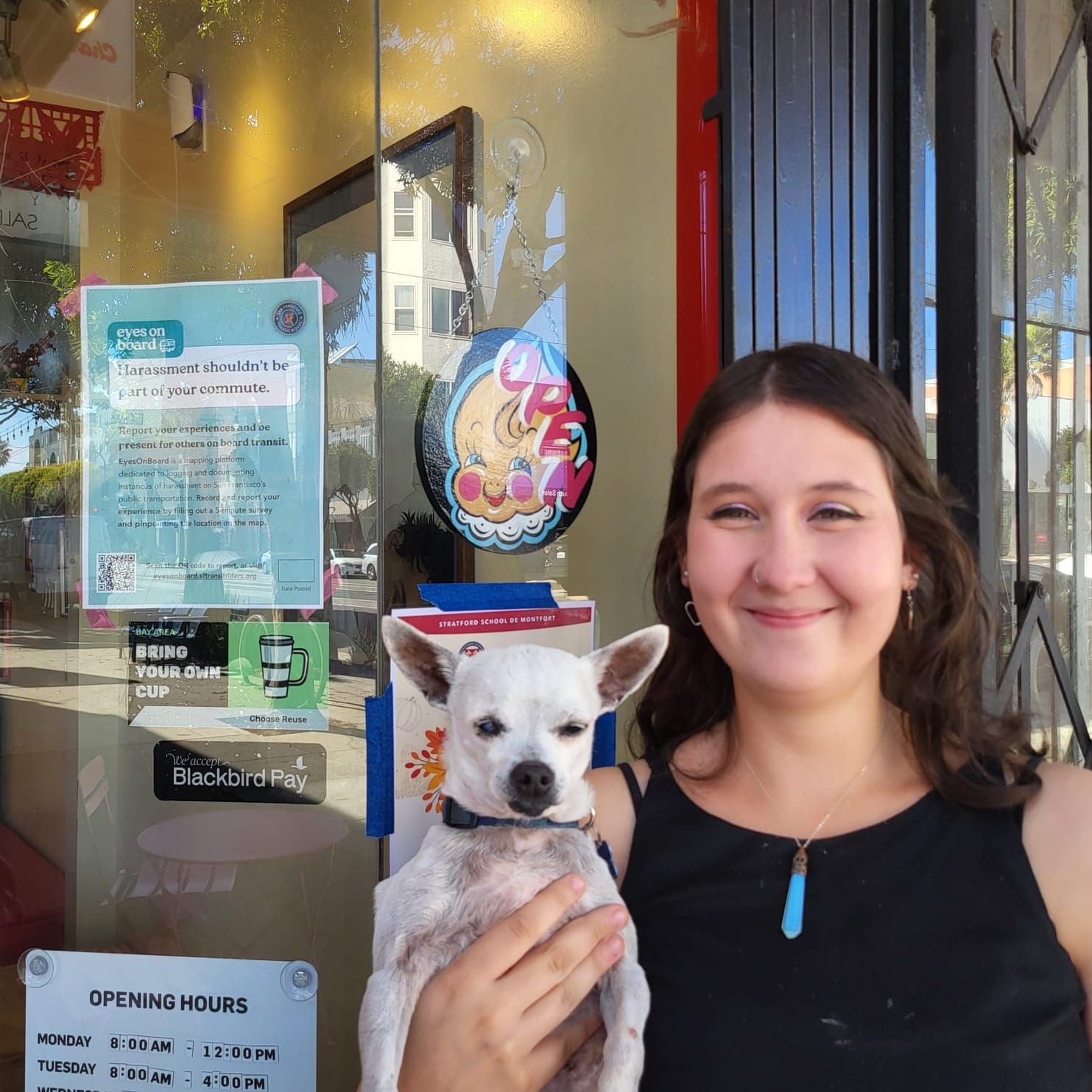
Indigo Rosenberg wants to end harassment on San Francisco’s transit system.
The 23-year-old Ingleside resident and London native has dealt with various types of harassment herself, even altering her routes to and from home to avoid it. She said she was inspired to examine how harassment affects mobility for her senior thesis at San Francisco State University. Rosenberg launched Eyes On Board, a site designed to document incidents of harassment on public transit in November 2025. Though she has recently graduated and now works at Market Street Railway, the project is still ongoing with no plans to end it anytime soon.
“I was just chatting with my friends, and we had one of those hour-long conversations where you just talk about everything, every piece of harassment you’ve experienced, and it made me realize how prevalent harassment is everywhere and how prevalent harassment is on transit,” Rosenberg said.
The website, created with help from the San Francisco Transit Riders, allows anyone to log incidents of harassment they endure or witness while on any Muni line or stop. It is tailored toward San Francisco-based transit routes, but Rosenberg plans to expand to other parts of the Bay Area soon.
Rosenberg hopes it starts an important dialogue for those experiencing or witnessing harassment and that it no longer becomes a taboo topic. She also hopes that the data collected will be used by the corresponding transit agencies to see what else can be improved to make improvements such as more lighting.
“I just want people to know that harassment is an issue and it’s something that is going to get better but only if people acknowledge it as such,” Rosenberg said. “Put eyes on it.”
The Ingleside Light caught up with Rosenberg to learn more about Eyes On Board.
This interview has been edited for length and clarity.
What is the importance of Eyes On Board?
The first part is just collecting data. That’s really important. A lot of people don’t report these things, and it all ties into each other. Another part is just solidarity. More people will report if they see other people reporting, and this feels like an issue that’s really swept under the rug. I grew up just not talking about it, and I feel a lot of people can relate to that, where it’s just not really talked about as big of an issue as it is. That’s also another part: to just get people in solidarity with each other, just emphasize how big of an issue this is and the scale and frequency of this issue. Then the other one is just understanding because I feel like if it doesn’t happen to you, you don’t understand. That’s kind of improved, as I’ve done this and the response I’ve gotten. The last really big point is just education; it’s educating people on how to safely mitigate these issues from a bystander standpoint as well, because I think the bystander effect is a really big issue.
What will happen with the data collected from this project?
I hope to share the data with SFMTA. They seem pretty happy to collaborate. I think there will be a really positive collaboration between us. They have really been addressing this issue. I think they just align with a lot of the points of the project. They do realize this is something that’s stopping people from riding and that this is a part of equity. I think they launched their harassment campaign in 2022 or 2023, and they have definitely been taking really good steps to address harassment.
If I expand it, I hope to also work with those transit agencies as well, but aside from that, I kind of just want to study the data. I just really like to do research, so it’ll be really cool having such a big database to work with. I’m planning on going to grad school next year, so hopefully, I’m taking that to grad school and maybe doing a big study on that.
How do you hope this project shapes the rider experience going forward?
I’ve had a lot of people being like, “Do you think this is going to stop harassment?” And I’m like, “No, that's not going to stop harassment because harassment is just a part of a much, much bigger social issue that’s been going on since literally the beginning of humanity.” I just think a lot about when I was 18 and experiencing all of that. I hope I can help girls the same age, in the same boat, just kind of realize this is not normal, this was not my fault and also more girls grow up with this being talked about as an issue because it feels really alienating growing up and kind of experiencing this and being so aware of being a woman. I think just more girls growing up knowing that this isn’t normal and this is something they should talk about and, just as a whole, more people acknowledging that this is an issue because it leads to bystander intervention.
What is one piece of advice you have for someone who experiences harassment and for those witnessing harassment?
The first piece of advice for bystanders is that it’s not a one-size-fits-all type of thing. Always think about the situation. This isn’t the most professional advice, but it's just a common-sense thing. Think about the situation. Don’t put yourself at risk. If you can tell it’s a fight you’re not going to win, don’t put yourself at risk. Distraction is good. Try to get the victim to come sit with you or try to get other people on board. I think once one person kind of helps, that kind of helps a little bit. If you are going to intervene, just keep it short. I would definitely direct people to the five D’s framework: Distract, delegate, document, delay and direct. That is what I have gone off of. That’s an academic framework for bystander intervention.
For the person being harassed, one of the most important things is just to document what you can, and honestly, my advice is just don’t blame yourself. You’re not going to be a perfect victim, and that is OK. It’s okay if you don't document it. It’s OK if you forget these things in the moment.


