

Rarely does "free" really mean "free,” but it does at City College.
When Free City launched in 2017, San Francisco became the first major American city to offer all its residents a tuition-free college education. A voter-approved tax on property sales above $5 million funds the program, and eligibility doesn’t depend on income, age, or course load. Over 20,000 San Franciscans took advantage of the program in the 2024-25 academic year, according to the Free City oversight committee’s annual report.
City College of San Francisco was founded in 1935 and began offering classes without a campus of its own. Morning classes met at a University of California extension building on Powell Street, while afternoon classes were held at Galileo High School. Students took streetcars between them, earning the school the nickname “Trolley Car College.” A 1938 ad campaigning for a central campus showed a student “Running Around San Francisco for an Education.”
The permanent 56-acre Ocean Campus opened in Ingleside in 1940. The college eventually separated from the school district in 1970 to form its own district. Today, it operates five centers in addition to the main campus — Chinatown, Downtown, Evans, Mission and John Adams — and offers a catalog of online courses, as well.
Its Culinary Arts program is the oldest in the country. Nursing, social services, fire science and auto programs all feed into the local job market. The college also offers a wide breadth of arts programming, from jewelry making to guitar lessons. Whether you’re looking for personal enrichment or making a career change, here’s how to enroll.
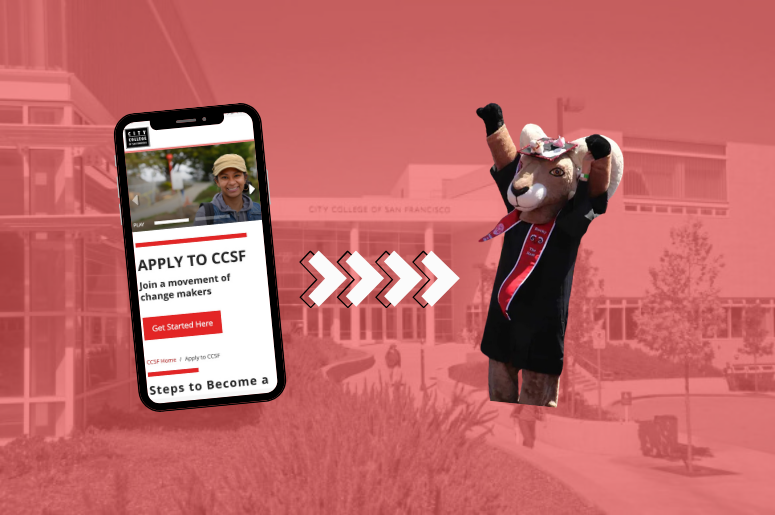
Eligibility Requirements Check
To take advantage of Free City, students need two things: California residency and a San Francisco address. California transplants must have lived in the state for at least 366 continuous days before the first day of school to establish residency. Exemptions for non-residents also exist, such as AB 540. More information on residency and exemptions is available here.
Step 1: Apply to City College
Those who have never enrolled at City College or haven’t taken a class in more than 2 semesters will need to fill out the CCCApply application. It involves entering personal information to create a profile in their system — no essay questions required. A valid email address is necessary since that’s how the college sends further communication about the application. A welcome email should arrive within about 72 hours of hitting “submit.”
The application will also ask for a mailing address, Outreach Coordinator Danielle de Brouin said. This is where it's important to enter your San Francisco address to get flagged in the system and receive the Free City benefits.
Students who run into problems, or who aren’t comfortable with an entirely online process, can complete the application and registration at the Student Success Center instead. Student Ambassador Gabriela Ortega describes the building as a “one-stop shop” for anyone interested in enrolling at the college.
She recommends bringing an email address, phone number, and some form of personal identification for the initial application. Once your application is processed, students can return to get an ID photo taken.
Step 2: Register for Classes
Once students receive an ID number and email address, they can log in to the myRAM portal. There, they can view their assigned registration date and time, then sign up for classes. Registration for all students typically opens a couple of months before the semester begins, and popular classes can fill up quickly. It’s worth adding courses as soon as the window opens rather than waiting.
“It’s the same registration process for everyone, whether you’re a full-time student or just taking one class,” Ortega said.
Step 3: Free City Confirmation
In the process of registering for classes, students are presented with a screen titled “Free City.” This is where the magic happens. It asks for a signature and confirmation of San Francisco residency, and the next screen notifies students of their eligibility. Every semester, students must restate their eligibility with the same form.
What Free City Covers
Free City waives the per-unit enrollment fee, currently $46 per unit, with no cap on units. “It’s an incredible opportunity to further and remove barriers to higher education,” de Brouin said.
It doesn’t cover everything, though. Students are still responsible for a handful of other fees each semester, including a health fee, activity fee, and representation fee. This will typically add up to less than $40 per semester. Depending on the course, students may also have to purchase additional materials and textbooks.
One important note: if you drop a class after the refund deadline, or an instructor drops you from a class, Free City requires students to repay the tuition it covered.


